
Nearly six months old.
Chris Hudak
View the Digital Edition | Sign Up
Take your latest CGI of an improbably-hued accretion disk and shove it. I wanted to watch future or other-world parents ragging on their conflicted, rebellious teenaged offspring;
Resources:
Caprica DVD
http://www.capricadvd.com/
Jane Espenson
http://www.janeespenson.com/[From Down To Earth: An interview with Caprica Executive Producer Jane Espenson]
I’ve seen the first few episodes of this now, and it’s very good. Good enough that cancellation is inevitable I fear 🙁
What Do the Experts Say?
Ben Goertzel, Seth Baum, Ted Goertzel
View the Digital Edition | Sign Up
When will human-level AIs finally arrive? We don’t mean the narrow-AI software that already runs our trading systems, video games, battlebots and fraud detection systems. [From How Long Till Human-Level AI?]
It’s been RSN for a long time 😉
Insightful reporting based on interviews with current and former Microsoft employees:
“When I started at MSFT in 1996, there were six people between me
and [Microsoft cofounder] Bill Gates,” Boris said. “In 2009, there
were 13 people between me and [Microsoft CEO] Steve Ballmer.” Fred
said, “the number of managers between me and the CEO went from six
to 10,” during the last decade. Another long-time Microsoftie,
whom I’ll call Barry, saw his reports go from six to 12.Fascinating stuff, too, about the bizarre incentive structure for Microsoft employees. I think this gets to the nut of exactly what’s wrong with Microsoft. They’ve evolved a powerful, deep bureaucracy that has lost any sort of focus on creating great products. Worse, for obvious reasons Microsoft’s management is unlikely to see itself as the problem. As Upton Sinclair said, “It is difficult to get a man to understand something when his salary depends upon his not understanding it.”
★
Interesting stuff.
Bumper year for finger-friendly phones The world’s smartphone makers shipped more touchscreen models in Q4 2009 than at any time in the past – and more touchphones than devices with buttons.…The power of collaboration within unified communications [From Touchscreens take lead in smartphone biz]
And Apple is the leader in touchscreen smartphones.
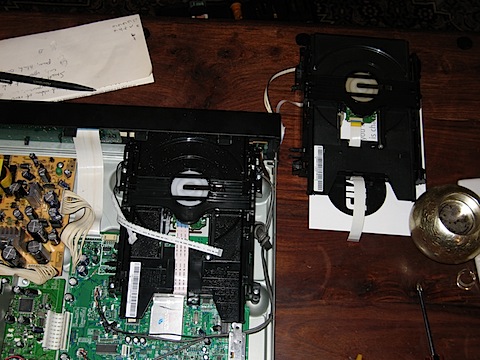
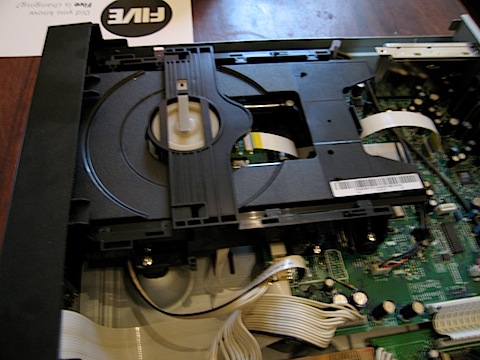
Today I opened up my home theatre system to clean the lens on the DVD player with a cotton bud and some isopropyl alcohol as it was beginning to get a bit fussy about rental disks (which tend to be dirty). This was the first time I’ve had to clean it since replacing the whole DVD drive mechanism a while back. It should work with occasional cleaning for a few more months and then I’ll need to replace the whole optical drive again. Or get a new home theatre system.
This is what it looks like inside from when I replaced the drive mechanism.
New drive installed except for attaching the cables.
The old drive before it came out.
It’s a sad tale, if you hear Dick Brass tell it. In a new op-ed for the New York Times, the former Microsoft VP explains how he thinks the Microsoft corporate culture has “never developed a true system for innovation,” and that while the company is obviously strong at the moment, he doesn’t see the company retaining its dominance if or when the Office and Windows revenues die down. His own anecdotes are a little heartbreaking: his team developed ClearType (first announced in 1998), but due to infighting and jealousy within the company, was kept from shipping as a default until 2007 with Windows Vista. Similarly he argues that the Tablet PC was much restricted by an Office team that didn’t believe in the concept, and therefore never developed a version of Office that was stylus-friendly. Dick left the company in 2004, and he says the tablet group at Microsoft has since been eliminated, and that almost all the executives in charge of “music, e-books, phone, online, search and tablet efforts over the past decade” have also left. The man isn’t out to get Microsoft: he sees the company as important, and its profits have obviously gone to great philanthropic ends through Bill Gates and others, but if what he says about the anti-innovative corporate culture is true, it sounds like Microsoft has some work to do before it can return to its place of preeminence as an innovator, instead of the fast and effective follower it seems to be becoming in many areas.Former Microsoft VP Dick Brass weighs in on why Microsoft ‘no longer brings us the future’ originally appeared on Engadget on Thu, 04 Feb 2010 09:31:00 EST. Please see our terms for use of feeds.Permalink | New York Times | Email this | Comments [From Former Microsoft VP Dick Brass weighs in on why Microsoft ‘no longer brings us the future’]
Moribund and soon to be beleaguered Microsoft lost its way many years ago.
Ordered Monday, arrived Tuesday and put on charge overnight (16 hours required before use) set up today.
Sennheiser RS-130 and HDR-130. Base station and two sets of headphones.

Supplementary headphones.

Just two little AAA NiMH batteries.

Base station and head set.


Installed in the home theatre room for late night viewing of 24, Lost and other noisy shows.

The base station charges two sets of headphones OK.
The SKY HD box conveniently outputs an analog stereo signal simultaneously with the optical digital 5.1
UPDATE: 4 Feb 2010.


Today this SCART->3.5mm headphone adapter arrived and I found it worked to get stereo out of my home theatre unit so now I can get headphone sound while watching DVDs or AVIs on a USB flash drive. The sound out on the SCART turns on when the HT speaker volume is set to Min (0).
Dismissing Apple’s iPad is understandable. Given its simplicity and evident shortcomings, it’s easy to see why the tech elite might have little use for it. But the volume and insistence of the wrath, the sheer bloody outrage, is remarkable for a product only a few people have even used. What, exactly, do we have to fear from the prospect of a high-quality, non-user-servicable computing appliance? Heeere’s Joel:
The iPad isn’t a threat to anything except the success of inferior products. And if anything’s dystopian about the future it portends, it’s an American copyright system that’s been out of whack since 1996.
Titled “iPad Snivelers: Put Up or Shut Up”, his is an angry rant, but of great value in it is the distinction between the right to hack and the value of attacking products whose design makes hacking difficult. Like those he criticizes, however, Johnson doesn’t quite address the other issue that makes it all so murky: Apple’s near-total control of its mobile software ecosystem, and the brewing battle between it and Amazon over ebook publishing.
To me, the answer seems paradoxical. We have everything to fear from computers like the iPad, because it marginalizes computer tinkering as a hobby and threatens to turn it into an ivory-tower discipline like heart surgery or architecture. But there’s also nothing to fear, because hacking is a way of thinking and if low-end computers finally become unserviceable black boxes, there’s plenty of other things to hack.
That’s why Joel’s final point is the best one: it’s far more important that we attack bad laws like the DMCA than the hacker-averse product design it engenders.
Also, if you hate the iPad’s limitations, Dell’s Mini 5 might be the droid you’re looking for. Check it out.
“iPad Snivelers: Put Up or Shut Up” [Gizmodo]
Most of these ‘openness’ whiners are just parroting talking points they clearly don’t actually understand and close to none of them could program their way out of a wet paper bag.
Powered by WordPress
